When it comes to the manufacturing of fins, the question of whether a fin forming machine can produce fins with different cross – sections is a critical one, especially for industries relying on efficient heat transfer mechanisms. As a supplier of fin forming machines, I am delighted to explore this topic in depth and shed light on the capabilities of our equipment. Fin Forming Machine
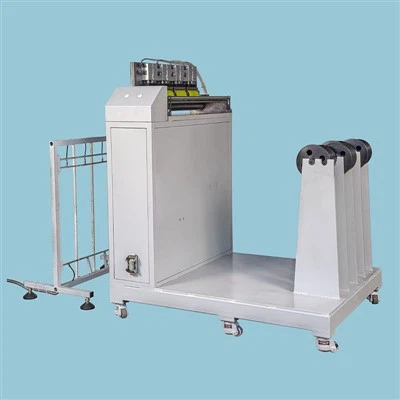
Understanding the Basics of Fin Forming Machines
Fin forming machines are designed to fabricate fins, which play a crucial role in heat exchangers by increasing the surface area available for heat transfer. These machines work by taking a strip of metal, typically aluminum or copper, and shaping it into a fin with a specific profile. The basic operation involves feeding the metal strip through a set of rollers or dies that gradually deform the material into the desired shape.
The design of most modern fin forming machines is based on a modular approach. This modularity allows for a great deal of flexibility in the types of fins that can be produced. Different sets of rollers or dies can be installed on the machine to create various cross – sectional shapes. For example, in a typical heat exchanger, we often encounter fin cross – sections such as the straight – fin, wavy – fin, and louvered – fin. Each of these cross – sections has its own unique characteristics and advantages when it comes to heat transfer efficiency, pressure drop, and air – side performance.
Producing Straight – Fin Cross – Sections
One of the simplest fin cross – sections that a fin forming machine can produce is the straight – fin. Straight fins are often used in applications where a straightforward and cost – effective heat transfer solution is required. The manufacturing process for straight fins is relatively uncomplicated. The metal strip is passed through a series of rollers that gradually bend the material into a straight, rectangular – shaped fin.
Our fin forming machines are equipped with high – precision rollers that ensure the straightness and uniformity of the fins. The settings of the machine can be adjusted to control the height, thickness, and pitch of the straight fins. This level of adjustability allows manufacturers to customize the straight fins according to the specific requirements of their heat exchangers. For instance, in an air – cooled condenser, the straight fins may need to be taller and more widely spaced to accommodate a larger volume of air flow, while in a small – scale electronic cooler, the fins may be thinner and more closely spaced to maximize the heat transfer area within a limited space.
Creating Wavy – Fin Cross – Sections
Wavy fins offer enhanced heat transfer performance compared to straight fins. The wavy pattern disrupts the boundary layer of the fluid flowing over the fins, promoting better mixing and thus increasing the heat transfer coefficient. Producing wavy fins requires a more complex set of rollers or dies in the fin forming machine.
Our advanced fin forming machines are capable of precisely forming wavy fins with different amplitudes and wavelengths. The dies are carefully designed to ensure that the waves are evenly spaced and have a consistent shape. When manufacturing wavy fins, the machine feeds the metal strip through a series of contoured rollers that gradually bend the material into the desired wavy pattern. The forming process is highly controlled, and our machines are equipped with sensor systems that monitor the quality of the fins in real – time. Any deviations from the specified dimensions or shape can be detected immediately, allowing for timely adjustments to be made to the machine settings.
Manufacturing Louvered – Fin Cross – Sections
Louvered fins are another popular type of fin cross – section known for their excellent heat transfer efficiency. The louvers, which are small slits or openings in the fin surface, further disrupt the boundary layer of the fluid, enhancing the heat transfer rate. Producing louvered fins is a more intricate process compared to straight or wavy fins.
Our fin forming machines are specially engineered to create louvered fins with high precision. The machine uses a combination of cutting and forming operations to create the louvers. First, the metal strip is fed through a set of cutting dies that create the louver slits at the appropriate intervals. Then, the strip is passed through a series of forming rollers that shape the fin into its final form. The design of the cutting and forming tools is crucial in ensuring the quality of the louvered fins. Our R & D team continuously works on improving the tool design to optimize the louver shape, size, and orientation, which in turn improves the heat transfer performance of the fins.
Advantages of Using a Single Machine for Different Cross – Sections
One of the key advantages of our fin forming machines is their ability to produce fins with different cross – sections using a single machine. This offers significant cost savings and increased flexibility for manufacturers. Instead of investing in multiple machines for each type of fin, they can use one machine to produce a variety of fin cross – sections, reducing the initial capital investment.
Moreover, the ability to switch between different fin cross – sections quickly allows manufacturers to respond more effectively to changes in market demand. For example, if a particular heat exchanger design requires wavy fins for better performance, the manufacturer can easily reconfigure our fin forming machine to produce wavy fins without having to purchase a new machine. This agility in production can give manufacturers a competitive edge in the market.
Customization and Quality Assurance
As a fin forming machine supplier, we understand that different customers may have unique requirements for their fin cross – sections. That’s why our machines are designed to be highly customizable. We work closely with our customers to understand their specific needs and can modify the machine settings or tooling to produce fins with custom cross – sections.
In addition to customization, we place a strong emphasis on quality assurance. Our fin forming machines are built to the highest standards of precision and reliability. We use state – of – the – art manufacturing techniques and high – quality materials in the construction of our machines. Each machine undergoes rigorous testing before it is delivered to the customer to ensure that it meets our strict quality requirements.
Conclusion

In conclusion, a well – designed fin forming machine, such as the ones we supply, can indeed produce fins with different cross – sections. Whether it’s straight fins, wavy fins, or louvered fins, our machines are capable of fabricating high – quality fins with precision and consistency. The ability to produce different fin cross – sections on a single machine offers significant advantages in terms of cost, flexibility, and quick response to market demands.
Fin Press Machine If you are in the market for a fin forming machine that can meet your diverse fin manufacturing needs, we invite you to contact us for a detailed discussion. Our team of experts is ready to provide you with comprehensive information, customized solutions, and technical support to help you make the right choice for your business.
References
- Incropera, F. P., & DeWitt, D. P. (2002). Fundamentals of Heat and Mass Transfer. John Wiley & Sons.
- Kays, W. M., & London, A. L. (1998). Compact Heat Exchangers. McGraw – Hill.
- White, F. M. (2006). Heat Transfer. Addison – Wesley.
Suichang Lvye Machinery Co., Ltd.
We are one of the most professional fin forming machine manufacturers in China, also support customized service with low price. We warmly welcome you to buy discount fin forming machine for sale here from our factory. If you have any enquiry about quotation, please feel free to email us.
Address: No. 402, Mudanting East Road, Miaogao Street, Suichang County, Lishui City, Zhejiang Province
E-mail: L528753@outlook.com
WebSite: https://www.suichanglvye.com/
